

What Is the Future of IT Service in 2026
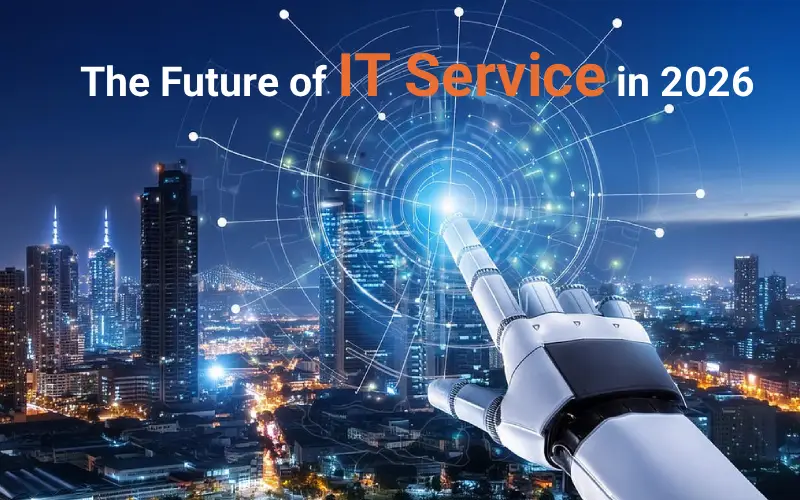
IT services will change by 2026 through artificial intelligence, which will automate IT processes, enhance cybersecurity, enable predictive maintenance, and support cloud optimisation. AIOps, machine learning, and intelligent automation enable organisations to identify issues more quickly, minimise downtime, and provide more effective support for IT services.
Why is artificial intelligence becoming the foundation of modern IT?
Artificial Intelligence has ceased to be a buzzword in the technological world. In 2025, AI has been developed to be not an experimental innovation but a critical source of business change within the IT services field. Companies across industries are using AI to automate daily operations, improve decision-making, and increase process efficiency.
From intelligent automation to sophisticated analytics, AI-based IT solutions are helping firms re-architect their operating models and unlock new opportunities in IT management. Machine learning, predictive analytics, and natural language processing technologies are enabling IT systems to become more intelligent and, in ways never before seen, respond more quickly to issues.
With the speed of the digital transformation, artificial intelligence is emerging as an essential component of creating smarter, faster, and more resilient IT infrastructures.
What is the Current Position of AI in IT?
At present, AI has become part of mainstream IT operations. Companies, both global and innovative startups, are already using AI-based tools to optimise IT activities and enhance their service delivery.
The application of machine learning in IT has become widespread for predictive maintenance, intelligent ticket routing, surveillance, and optimisation of system performance.
With advances in natural language processing (NLP), deep learning, and algorithms, IT systems today can process vast volumes of data, learn from experience, and provide smart recommendations.
The greatest benefit is automation. Activities previously performed by human supervisors, such as infrastructure monitoring, incident management, and system diagnostics, can now be handled by intelligent systems that run 24/7 with minimal human involvement.
In what area of the IT services is AI having the most significant effect?
With advances in natural language processing (NLP), deep learning, and algorithms, IT systems today can process vast volumes of data, learn from experience, and provide smart recommendations. Mundane, routine jobs are being substituted by mastermind systems that operate day and night with minimal intervention.
What Role Is AI Playing in IT Service Management (ITSM)?
IT Service Management has improved greatly with the help of artificial intelligence. Tier-1 support requests and service tickets can now be automatically sorted and sent to the corresponding teams by AI-powered chatbots and virtual assistants.
AI-powered portals enable customers to troubleshoot issues on their own, reduce response times, and enhance customer satisfaction. This smart automation allows IT teams to focus on more challenging problems rather than repetitive support tasks.
Is AI Capable of Enhancing Cybersecurity and Threat Detection?
One of the most significant spheres where AI is affecting cybersecurity is strong. The machine learning models can examine network traffic patterns and identify anomalies in real time.
AI-based security systems can identify potential threats, insider attacks, or unusual system behaviour quickly, before they cause significant harm. Predictive analytics allows organisations to enhance their security stance proactively, and thus AI is a key element of current cyber defence policies.
What is the AI Optimisation in Network and Infrastructure Monitoring?
Conventional infrastructure monitoring was mainly based on reactionary troubleshooting. This has been changed by AI, which has brought about predictive monitoring.
IT departments can anticipate system failures, identify performance bottlenecks, and optimise the use of network resources before disruptions occur, using AI-driven analytics. Such forecasting power reduces downtime and promotes smooth business operations.
Is AI the Solution to More Intelligent Cloud Management?
The management of cloud infrastructure has become increasingly complex with the rapid integration of hybrid and multi-cloud environments. With AI, it becomes easier to manage cloud resources by leveraging demand patterns and automatically scaling resources.
Cloud optimisation tools that use AI will help companies reduce operational expenses while maintaining optimal system performance. Intelligent resource and workload balancing is automated to make cloud environments efficient and scalable.
What Is AI Doing to Better IT Support and Help Desk?
AI-powered IT support systems have become more intelligent and contextual. With historical data and user interactions, AI can suggest solutions or even solve the problem automatically.
Such a high degree of intelligent automation will significantly reduce resolution time and enhance the overall user experience. IT support staff can now focus on strategic activities rather than routine troubleshooting.
Why Is AIOps the New Centre of IT Operations?
AIOps, or Artificial Intelligence in IT Operations, has become an influential tool for managing complex IT ecosystems. AIOps platforms automate IT operations and make them more efficient by merging big data analytics with machine learning.
The major features of AIOps are:
Event Correlation: Linking related alerts of different systems.
Root Cause Analysis: Immediately identifying the main reason for failures in the system.
Predictive Analytics: Outage and performance prediction.
Automated Remediation: automated fixing of technical issues that keep happening.
AIOps platforms collect telemetry data from various sources, narrow down irrelevant signals, and deliver actionable insights. This enables IT departments to stop focusing on reactive maintenance and start looking at strategic innovation.
What are the key Business Advantages of AI-Based IT?
Companies that are applying AI in IT services are enjoying considerable benefits:
1. Increased Operation Efficacy.
Overall, AI processes large amounts of data in a few seconds, allowing faster decision-making and problem-solving.
2. Reduced Operational Costs
Automation reduces manual handling and improves resource utilisation, resulting in long-term savings.
3. Improved User Experience
AI-driven chatbots and automated support systems provide prompt, more precise answers.
4. Predictive Maintenance
Quickly identifying system failures saves time and prevents business loss.
5. Increased Scalability and Agility.
The IT infrastructure becomes more flexible and responsive as AI systems can easily adapt to changing business requirements.
What are the challenges associated with the adoption of AI in IT in an organisation?
Although AI-driven IT solutions offer benefits, they also present several challenges during implementation.
Data Security and Privacy:
The AIs are also highly dependent on large datasets, which creates issues with data ownership, compliance, and protection.
Skill Shortage:
The number of jobs requiring experts in AI, machine learning, and data analytics is on the rise. Many organisations are forced to invest in employee upskilling.
Integration to Legacy Systems:
Implementing AI technologies alongside legacy IT infrastructure can be tricky and time-consuming.
Trust and Transparency:
Certain AI systems are black-box, i.e. hard to comprehend the decision-making process. Elaborate AI is the key to gaining confidence.
How Will AI-Directed IT Services Perform in the Future?
The future of IT services will be smarter and self-directed.
Autonomous IT Systems:
Self-optimising and self-healing IT infrastructures will reduce the need for human intervention and enhance reliability.
Hyper automation:
Robotic process automation combined with AI will automate the entire business process.
Cognitive AI Assistants:
Next-generation virtual assistants will be able to read between the lines, learn to interpret conversations, and perform complex IT tasks.
Edge AI:
The rise of IoT and edge computing will bring AI closer to the source, enabling quicker decisions.
Democratisation of AI:
Non-technical users will be able to create AI-driven automations without writing a single line of code, using user-friendly tools.
Is this the Future of IT Services?
The role of AI is not only to improve IT services but also to redefine them completely. From smart automation to predictive analytics, AI is helping organisations realise a new era of efficiency, reliability, and innovation that has never been achieved before.
The major success factors for IT leaders are adopting AI strategically, continually acquiring new skills, and implementing intelligent technologies in daily processes.
There is one thing that the future of IT services will be: AI-driven, automated, and smarter than ever before.
|
|---|
Latest Blogs
-
 Google I/O 2025: Key Announcements, AI Breakthroughs & What It...
-
 Cyber Security and Data Protection: How will Businesses Secure their...
-
What Is the Future of IT Service in 2026
-
 Living Intelligence: Future of AI, Biotechnology & Smart Technology
Tags
- AIandBiotech
- Android updates
- CyberSecurity2026
- DataProtection
- DigitalAssetSecurity
- DigitalTransformation
- E-commerce Transformed
- FutureTech
- Google AI updates
- Google I/O 2025
- Google I/O live stream
- Google announcements 2025
- IT services
- IT services 2026
- InfoSecGlobal
- LivingIntelligence
- Shopping
- SmartTechnology
- StuffCore
- ZeroTrustArchitecture
- custom design
- designer
- developer
- future of IT services
